I Failed the Gaimen Kirikae by Two Marks. Ten Days Later I Was the Only One Who Passed.
· GaimenGo Team
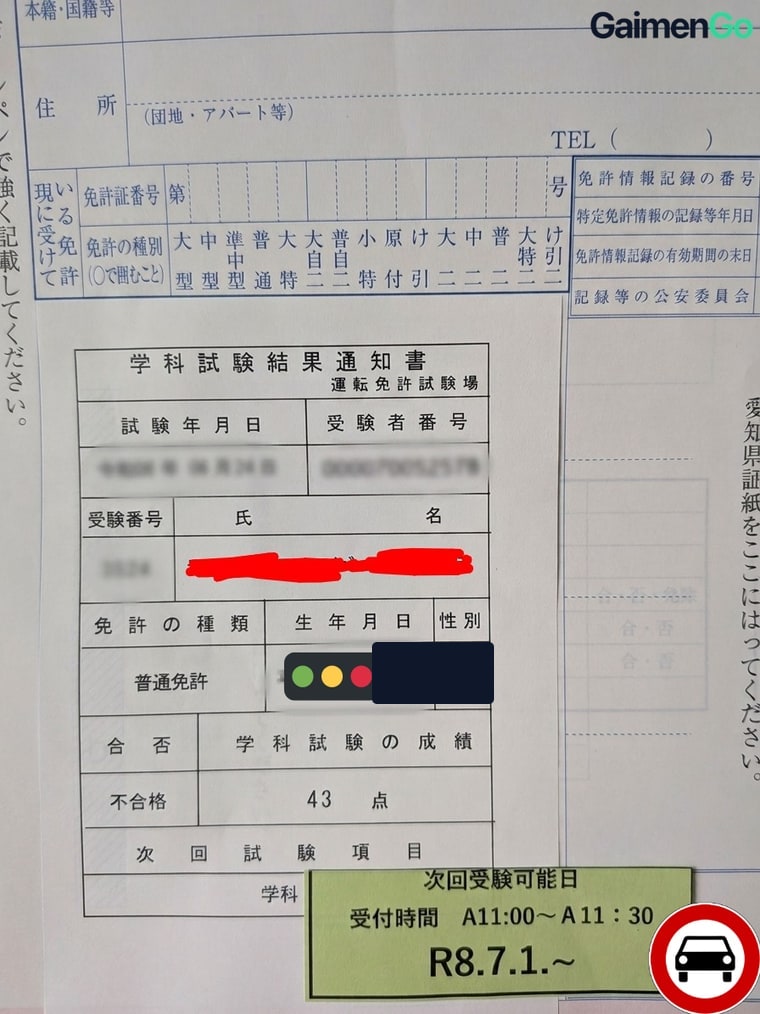
43 out of 50 on the first attempt — two questions short of the pass mark. I found GaimenGo in the waiting room that same morning, practised for ten days, and came back to a results board with one number on it. Both result slips included.
Forty-three out of fifty. The pass mark is forty-five.
I had missed the Gaimen Kirikae written test by two questions, and I would not be allowed to try again for a week.
If you have sat this test, you already know what went wrong. It is fifty true-or-false questions, you need ninety percent, and the English translation is not written by anyone who has ever taken a driving test. Sentences double back on themselves. "You may not proceed unless it is not unsafe to do so." You read a question four times, pick the answer that feels least wrong, and move on because there are forty-nine more.
Two of those coin flips went the other way and I would have passed. That is the part that stung.
The waiting room
Here is the thing I did not put in the first version of this post, because it sounds too convenient: I found GaimenGo on the morning of the test I failed.
I was in the waiting room at the licence centre with maybe forty minutes to kill, scrolling Facebook to keep my nerves down, and an ad for a free practice question bank went past. I tapped it mostly out of boredom. I did about ten questions in five minutes before they called us in.
I got two of them wrong.
That was the useful part. Not the questions I answered correctly — the two I was confident about and still got wrong. Both were the same kind of trap: a rule I *knew*, wrapped in phrasing designed to make me answer the opposite. I walked into the exam hall thinking "oh, that is what they are doing", about forty minutes too late.
The ten days
The slip they hand you when you fail tells you the earliest date you can come back. Mine said 1 July.
I did not do anything clever with those ten days. No textbook, no course, no study group. I did practice questions on my phone — on the train, in a queue, waiting for a kettle. Ten, maybe twenty minutes a day, in whatever gaps existed.
What changed was not how much I knew about Japanese road law. It was that I stopped being surprised by the sentences. After a few hundred questions, the phrasing tricks stop being tricks and become a pattern you recognise: the absolute words like *always* and *never* that are almost always false; the questions that describe a correct action but attach it to the wrong road type; the ones where the answer hinges on a single でも or 以外.
You cannot learn that from a rulebook, because the rulebook is not what is being tested. What is being tested is whether you can read the question.
7 July
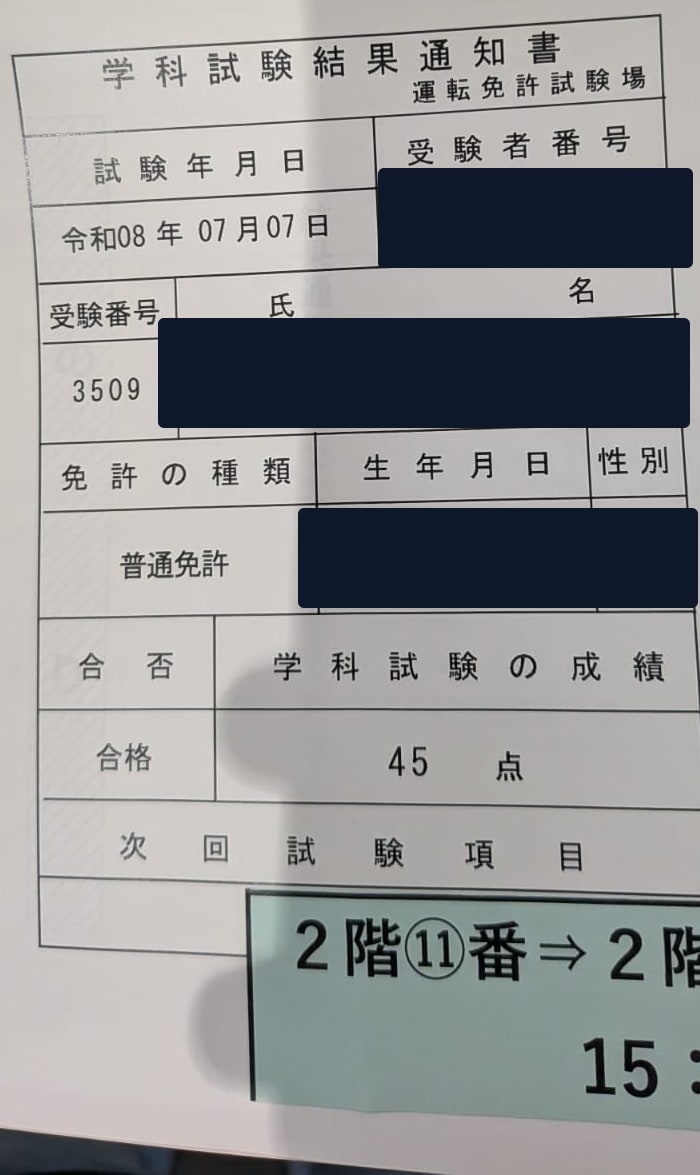
Forty-five. Exactly the pass mark, not a point more. I am not going to pretend that was comfortable.
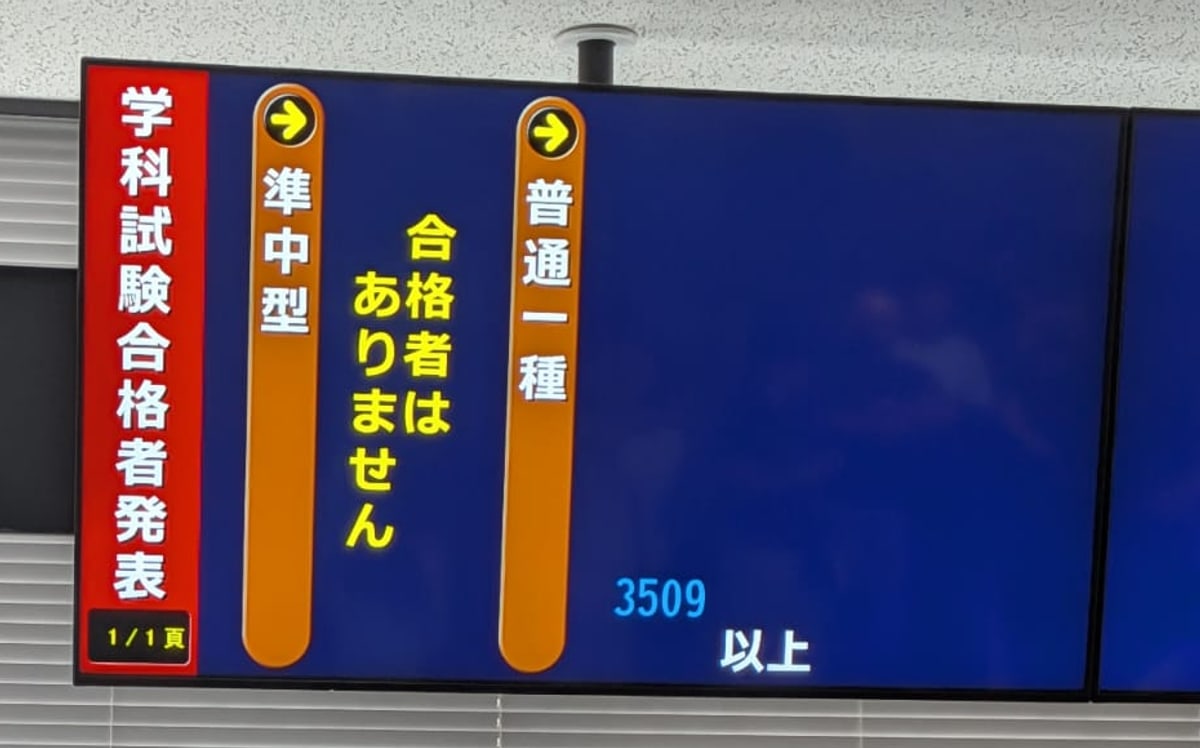
Then I went out to the hall where they post the results, and this is what was on the board:
Under 普通一種 — ordinary class one, the licence most foreign residents are converting to — there was one number. Mine. Then 以上, which is the Japanese way of saying *that is the complete list*.
The column next to it, 準中型, said 合格者はありません. No successful candidates at all.
I want to be careful about what that does and does not mean. It is one announcement, at one centre in Aichi, on one afternoon. It does not mean I was cleverer than everyone in that building. But it does tell you something true about this test that the official pass-rate statistics also tell you: most people sitting it are not ready, and they do not know they are not ready. I did not know either, the first time.
What I would actually tell you
- Do not confuse knowing the rules with being able to read the questions. They are separate skills and only one of them is on the exam.
- The pass mark is 90%. Five wrong out of fifty and you are done. There is no room to be casually confident about anything.
- Practise in the gaps, not in blocks. Ten minutes on a train, every day, beat any evening I ever set aside for studying.
- Get the questions wrong somewhere that does not cost you ¥3,000 and a day off work. That is the entire value of practice questions. Every one you fail at home is one you will not fail at the centre.
- If you have already failed once, you are not behind. You now know what the room looks like, how the paper is laid out, and how the phrasing works. I passed on the attempt where I was least nervous, not the one where I knew the most.
A note on who wrote this
I work on GaimenGo. That is my own result slip up there, with my name taken off it.
I am telling you that at the top rather than burying it, because a "user story" written by the people who built the product is worth a great deal less if you find out afterwards. Read it as what it is: one person's account, with the paperwork attached so you can check the parts that are checkable.
The two slips are real, the numbers on them are unedited, and 3509 on the board is the same 3509 on the pass slip. Everything else is just my memory of a fairly stressful fortnight.
If you are sitting this soon
Practise until the phrasing stops surprising you. That is the whole trick.
GaimenGo has 3,500+ free practice questions, including 490+ built on real Japanese road-sign images, and timed mock exams in the same fifty-question format with the same ninety percent pass mark. No sign-up, no payment.
Already booked your test? The conversion guide covers the documents and the booking process, and if you are converting in Aichi, the Hirabari written-test booking guide walks through the reservation system step by step.