Roundabouts in Japan: Everything You Need to Know About 環状交差点
· GaimenGo Team
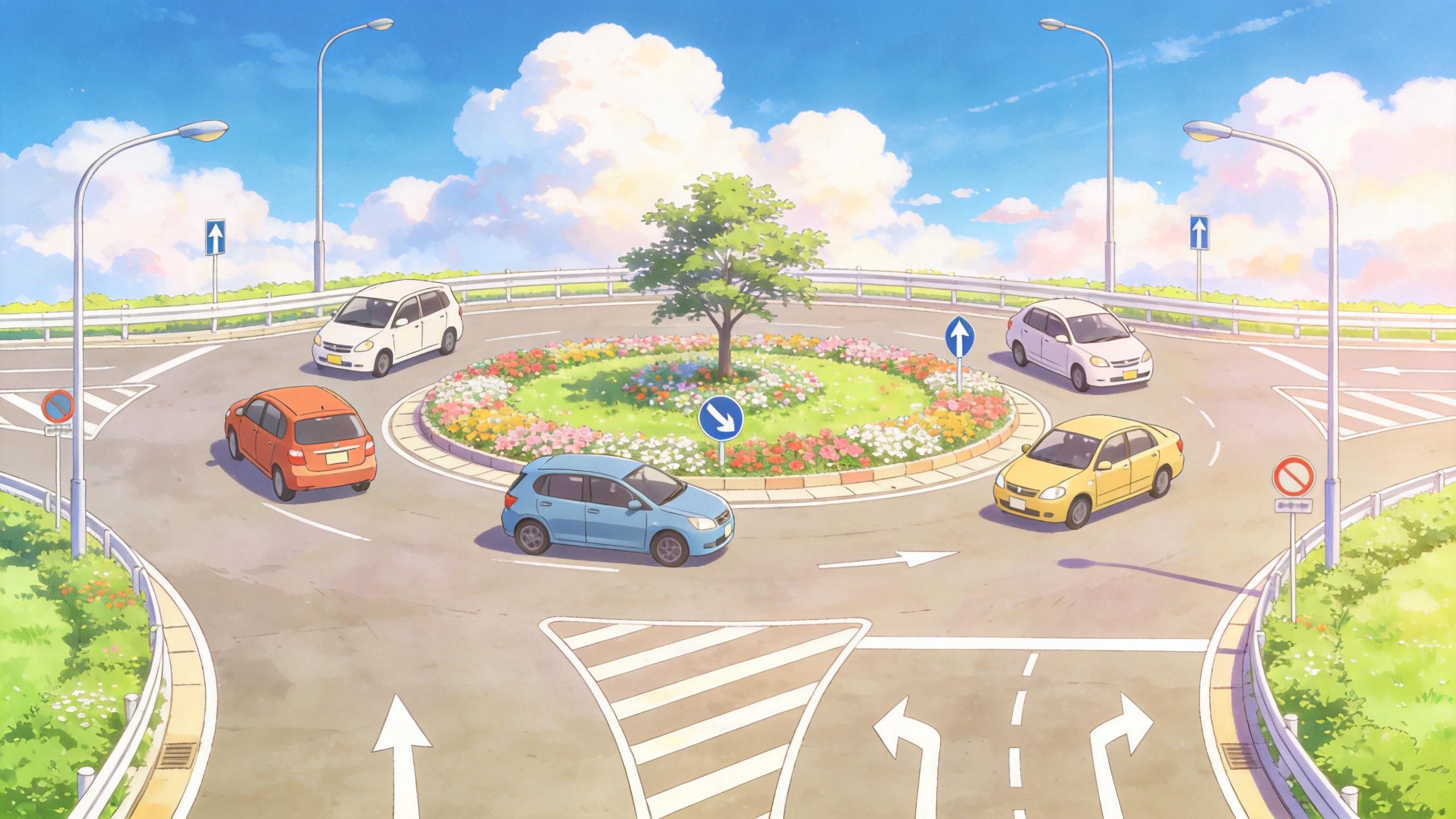
Roundabouts are rare but increasingly important in Japan. Here's the complete guide to 環状交差点 (Kanjō Kōsaten) rules for your driving test.
Japan's Roundabout: A Modern Addition to Traffic Law
Japan formally introduced roundabouts — called 環状交差点 (Kanjō Kōsaten — Circular Intersection) — into the Road Traffic Act in 2013. They remain relatively rare compared to Europe, but you need to know the rules for your 外免切替 (Gaimen Kirikae — Foreign License Conversion) test.
The blue circular instruction sign posted at the entrance — Sign No. 327-10 — shows three white arrows forming a loop. This is your visual cue that a roundabout is ahead.
The 5 Essential Rules
1. Traffic flows counterclockwise Japan drives on the left, so roundabout circulation is always counterclockwise (left) when viewed from above. This is opposite to roundabouts in right-hand traffic countries.
2. Circulating vehicles have absolute priority Under Article 37-2 (道路交通法第37条の2 — Dōro Kōtsū Hō Dai 37-jō no 2), any vehicle entering the roundabout MUST yield to vehicles already inside. There are no exceptions.
3. No full stop required on entry You must slow down (徐行 — Jokō — Slow Down/Yield Speed) and yield, but a complete stop is not mandatory unless traffic is present.
4. Signal LEFT when exiting — just before your exit The normal 30-meter advance signal rule does NOT apply inside roundabouts. Signal left only just before the exit you intend to take. No signal is needed when entering.
5. No traffic signals inside Roundabouts are signal-free by design. Priority is determined entirely by the circulating-traffic-has-right-of-way rule. This also makes them disaster-resilient during power outages.
Common Exam Traps
- 'Traffic in a Japanese roundabout flows clockwise' → False (it's counterclockwise)
- 'You must signal 30 meters before your exit' → False (signal just before the exit)
- 'You must stop completely before entering even if no vehicles are circulating' → False (yield, not full stop)
- 'Vehicles already circulating have priority over entering vehicles' → True
Why Japan Built Roundabouts
After the 2011 Tōhoku earthquake knocked out power across entire regions, traffic signals failed and intersections became dangerous. Roundabouts, which operate without electricity, were identified as a resilient alternative for disaster preparedness.
Reference: 道路交通法第37条の2 (Dōro Kōtsū Hō Dai 37-jō no 2 — Road Traffic Act Article 37-2), MLIT Roundabout Implementation Guidelines.